
Case study · Hot runner components
Angel Hill Technologies: a site that lets molders find the part they need
A maker of nozzle heaters and hot runner parts whose customers search by component when a mold is down. We built a compact site with a page for each product line and a direct route to someone who knows the parts.
The results for Angel Hill Technologies
Heaters, sensors and parts for injection molding
Angel Hill Technologies engineers and assembles injection nozzle heaters, including brass bushing designs and coil heaters, along with thermocouples and spare parts for hot runner systems. It also cleans hot runner manifolds and repairs damaged nozzle heaters, which often costs a molder far less than buying new.
Its customers are plastics injection molders and the toolrooms that keep their molds running. They know exactly what a hot runner is. What they need to learn is whether Angel Hill has the part, whether it will fit their OEM system and how soon it can ship.
The challenge: buyers who search for a part, not a company
A maintenance engineer with a failed heater does not search for a supplier by name. They search for the component: a nozzle heater for a particular system, a thermocouple of a certain diameter, a valve pin. A site that lists everything on one services page is unlikely to appear for any of those searches.
The company also competes with original equipment makers on price and delivery. That argument only works if the visitor can see quickly that the replacement is a direct fit and that an expert is available to confirm it.
What the new site had to do:
- Give heaters, thermocouples, maintenance and parts their own pages, each findable in search.
- State the specifics engineers look for: designs, configurations and OEM replacements.
- Put price and turnaround, the reasons to choose an independent supplier, where they are seen.
- Make it quick to reach a person who can answer a technical question.
What we built
A small, fast site with four clear sections. An engineer can go from a search result to the right product line and a phone number in two clicks.


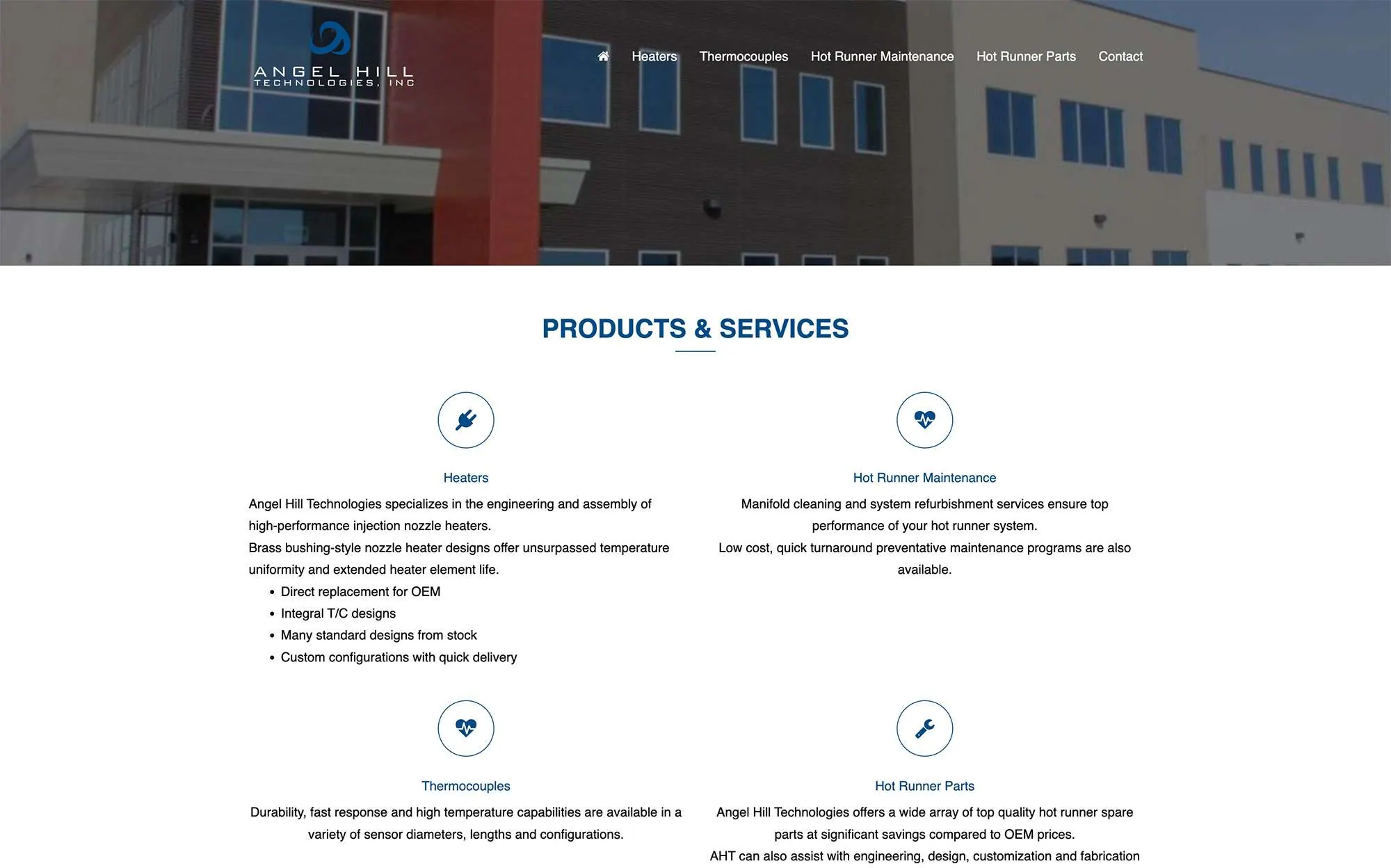


A home page that works as an index.
The four lines, heaters, thermocouples, hot runner maintenance and hot runner parts, are summarized side by side with a link to each. Nobody has to read about the company before finding the product.
A heaters page with real detail.
Brass bushing heaters, integral thermocouple designs, OEM replacements, cable elements and micro cable elements are each described, including which standard designs are available from stock and what can be made to order.
A maintenance page that explains the process.
Manifold cleaning is described step by step: what is removed from the melt channels, which resins it works on and why the end plugs stay in place. Heater repair is covered beside it.
A parts page that lists the parts.
Valve bushings, valve pins, seals, nozzle tips, insulators, heaters and housings are named individually. A buyer searching for one of them finds the word on the page.
Contact details on every page.
The phone number, email and address appear in the footer throughout, and product pages end with a button to order or ask a question. For custom heaters the site invites a call, because those jobs start with a conversation.
SEO written for the trade.
Page titles and headings use the terms molders use, such as "hot runner", "nozzle heater" and "OEM replacement", so the pages match what engineers type into Google.
How the project ran
Discovery
We went through the product lines with Angel Hill and asked how customers describe what they need when they call. Those phrases became the page headings.
Structure and design
Four sections, one per line of business, with a clean layout that keeps the technical copy readable.
Build and content
We built the pages and edited the product descriptions with Angel Hill, so the terminology is correct and the benefits are stated plainly.
Launch and search setup
The site went live with titles, descriptions and headings in place for each product line, ready for Google to index.
The results
The site answers the first question a buyer has, which is whether Angel Hill makes the part. Each product line has a page that says so in the customer's own terms, with the options listed.
Calls are more specific as a result. A molder who has read the heaters page asks about a particular design or OEM model, and the conversation moves straight to fit, quantity and delivery.
A small site is also easy to keep accurate. When a product is added or a specification changes, one page is updated and the rest of the site still makes sense.
Services on this project
Website Design
Page layouts designed around how this client's customers decide and buy.
Website Development
The build itself: fast, responsive pages and the custom features the project needed.
SEO
Titles, headings, structure and local details set up so the site is found in search.
In the same line of work? See how we build manufacturing websites.
Frequently Asked Questions
What other industrial suppliers ask us about this project.
Often it is better. Angel Hill's site has a handful of pages, each about one product line. A focused site that matches a few specific searches well will do more for a specialist than fifty thin pages.
They search for the component or the problem, not for a company. That is why each Angel Hill product line has its own page using the trade's terms. Our SEO page explains how we choose those terms and build pages around them.
List what a buyer needs to confirm fit: types, configurations and the OEM systems you replace. Prices for custom or quoted parts are usually better handled by a quick call or a quote request, which is how this site does it.
We write from your material and your words, and you check every page before launch. On this project the product descriptions were edited together with Angel Hill, so an engineer reading them finds nothing to correct.
More projects like this
-
LCM Industries
A hot runner service shop with deep technical knowledge and no simple way to explain it to a buyer in a hurry. We designed the logo and a website that says what the shop does, why it is quick and how to get a quote.
-
Watermark Fabrication
A commercial fabricator whose buyers are architects and contractors, each working in a different kind of building. We built a site sorted by industry, product and material, with a gallery of finished work and an expert one click away.
-
Configurable Management
A software company with a product that is hard to explain in one sentence: zero-code automation for SAP. We built a site that gives each product its own page and puts a demo request in reach of every visitor.
View Case Study: Configurable ManagementView the Website: Configurable Management


Tell us about your business
A few details are enough to start: what you do, who you want to reach and what you need help with.
Jason reads each request and replies in under 24 hours with next steps.